


AI

ChatGPT Business Profiles Are Here. Law Firms Need to Pay Attention.

OpenAI launched business profiles in ChatGPT. Here’s why law firms should claim theirs, what Business Hub tracks, and why agents matter.

November 12, 2026
November 12, 2026
Written by
Reviewed by
ChatGPT for law firms; chatgpt business for law firms

Overview:

Join other SEO and marketing professionals staying up-to-date with TruLaw Marketing.

Key Takeaways

  • Law firms may now have a more direct way to manage how their businesses are represented inside ChatGPT.

  • Business Hub appears to combine pieces of Google Business Profile, Analytics, and Search Console.

  • Claiming a profile will not automatically make ChatGPT recommend your firm.

  • The Business Agent is the part I believe has the most potential for law firms.

  • Mentions and clicks are useful, but cases are still what count.

ChatGPT Business Profile for Law Firms: What to Do Now

OpenAI just launched Businesses in ChatGPT.

If that name feels confusing, you’re not alone.

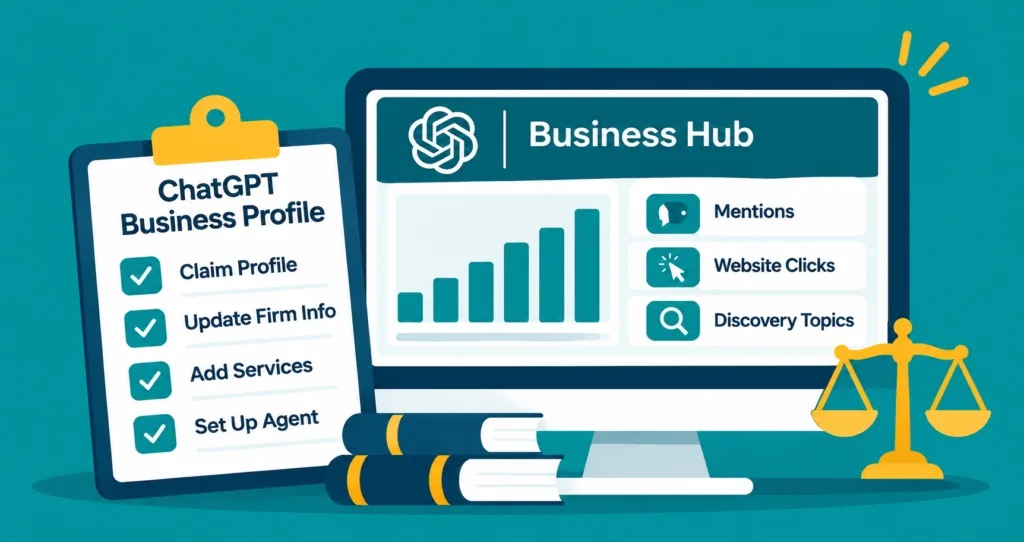
This is not ChatGPT Business, the paid workspace plan. It is a new system that lets eligible businesses claim their information inside ChatGPT, see some of the ways people are finding them, and potentially create an agent that can communicate directly with customers.

My first reaction?

This looks a lot less like another random AI feature and a lot more like the beginning of a real business discovery platform.

chatgpt business-profile law firms

For law firms, I think the easiest way to understand it is:

Google Business Profile + Google Analytics + Google Search Console—with an agent sitting on top of it.

That is how we are treating it at TruLaw Marketing.

And if you are my client, this is something we are paying attention to now. Not six months from now, after every other firm has claimed its profile and every marketing agency has suddenly become a “ChatGPT Business Profile expert.”

Right now.

What Did OpenAI Actually Launch?

OpenAI calls the broader program Businesses in ChatGPT.

There are really three pieces law firms need to understand.

A Business Profile

This is the basic listing.

It gives an eligible business a way to claim and manage information such as its name, website, services, locations, and contact information.

For law firms, that could mean more control over information like:

  • Firm name
  • Phone number
  • Website
  • Office locations
  • Practice areas
  • Attorney information
  • Consultation options
  • Hours and contact methods

This is the Google Business Profile part of the equation.

It gives your law firm an owned presence inside ChatGPT.

“Owned” comes with an asterisk because the platform still belongs to OpenAI. But it is more control than law firms have had up to this point.

Business Hub

Business Hub is where businesses can manage that information and review available insights.

OpenAI says businesses will be able to see things like mentions, website clicks, and discovery topics (and our team confirmed this today).

That matters.

Until now, law firms could test ChatGPT prompts and see whether they appeared. But there was very little reliable information about why they appeared, how often they appeared, or whether anyone did anything afterward.

Business Hub starts filling in some of those blanks.

The mentions and clicks feel a little like Analytics.

The discovery topics feel a little like Search Console.

Again, this is not a perfect comparison. OpenAI is not Google, and the available data will probably change as the platform develops.

But conceptually, that is how I am looking at it.

A Business Agent

Then there is the agent. This is the part I care about most… right now.

A Business Agent can answer questions using information supplied by the business. Instead of someone seeing a profile and leaving, they may be able to start a conversation with the firm’s agent.

That conversation could help someone understand:

  • Whether the firm handles a particular type of case
  • Which states or cities the firm serves
  • What a consultation involves
  • What information to gather before contacting the firm
  • How to reach the correct person
  • What the next step should be

The agent should not give legal advice. It should not guarantee results. And it should not pretend to be an attorney.

But it could become the bridge between being found and starting intake.
Why Should Law Firms Care?

People are already using ChatGPT to research legal problems.

They are asking:

  • “Do I need a lawyer?”
  • “What kind of lawyer handles this?”
  • “Who is the best attorney near me?”
  • “Which firms handle this type of lawsuit?”
  • “How much does it cost to hire a lawyer?”
  • “What should I do before I call an attorney?”

Some of those questions will lead to law firm recommendations. Others will shape the person’s expectations before they ever call. Either way, ChatGPT is becoming part of the decision-making process.

I have said this before: Google is not going away. Traditional search is not dead. SEO is not dead.

But the way people find and evaluate businesses is getting more fragmented.

Someone might discover your firm in ChatGPT, search your name on Google, read your reviews, watch a video, visit your website, and then call.

Which channel gets credit? Probably whichever platform happened to be last.That does not mean the other touchpoints did not matter.

Businesses in ChatGPT gives law firms a chance to take more control over one of those touchpoints.

That alone makes it worth setting up.

Let’s be honest, if you’re a lawyer, you don’t have time for all this. So, if you need help setting it up, we should talk.

Our Position: Treat This Like Google Business Profile, Analytics and Search Console

When Google My Business (GMB) / Google Business Profile (GBP) or whatever they are calling it now became important, a lot of law firms treated it like a minor directory listing.

Then local search became one of the most competitive parts of legal marketing. It’s why you guys give marketers like us 10’s of thousands of dollars $$ a month!

The firms that had already claimed their profiles, fixed their information, built reviews, added content, and learned how the platform worked had an advantage.

Everyone else had to catch up.

I think we may be looking at a similar moment here.

Not because ChatGPT is going to replace Google tomorrow. It won’t.

But because OpenAI is giving businesses three things inside one ecosystem.

Control Over Your Business Information

That is the Google Business Profile part.

Your firm can provide accurate information about who you are, what you do, and how people can reach you.

For law firms, accuracy is not a minor detail.

If ChatGPT shows the wrong phone number, that can cost a case.

If it says you handle a practice area you do not handle, that creates a bad experience for everyone.

If it sends someone to an old location or lists an attorney who left the firm two years ago, your brand looks sloppy.

Claiming the profile gives the firm a chance to clean that up.

Information About Engagement

That is the Analytics part.

If Business Hub shows mentions, clicks, or other engagement, law firms can begin answering a question that has been difficult to answer:

Is our visibility in ChatGPT producing any actual activity?

That is useful.

But let’s not get carried away.

A mention is not a lead. A click is not a signed case. An agent conversation is not automatically a qualified consultation.

We should track them. We just should not confuse them with growth.

Information About Discovery

That is the Search Console part.

Discovery topics may help law firms understand why they are appearing in ChatGPT conversations.

This could be even more useful than traditional keyword data because people communicate differently with ChatGPT.

A Google search might be:

Chicago truck accident lawyer

A ChatGPT prompt might be:

My husband was hit by a commercial truck outside Chicago, and the trucking company’s insurance carrier keeps calling me. What should I do?

Same general intent.

Completely different amount of context.

If Business Hub gives law firms insight into those themes, it could affect:

  • Content strategy
  • FAQs
  • Practice-area pages
  • Intake scripts
  • Agent responses
  • Advertising
  • Landing pages

That is not just a reporting tool.

That can become a planning tool.

The Profile Is Important. The Agent Is the Real Opportunity.

Claiming the profile is table stakes. It’s step one.

The agent is where (I think) the bigger opportunity sits.

At TruLaw Marketing, we are planning to really hone in on agent building for clients.

Not generic chatbots.

Not a little bubble on the website that asks for your name and email before giving you the same phone number already listed at the top of the page.

Actual agents built around how the law firm operates.

Because here is the thing: getting found is only part of marketing.

What happens next matters just as much.

If someone finds your firm at 10:30 at night and asks whether you handle their type of case, what should happen?

If they are in the wrong state, where should they go?

If they describe a situation that could fit two different practice areas, what questions should the agent ask?

If the question crosses into legal advice, when should the agent stop?

If the potential case appears to meet the firm’s criteria, how should the person reach intake?

These are not copywriting questions.

They are marketing, technology, operations, compliance, and intake questions.

That is why building the agent correctly matters.

OpenAI’s own guidance describes agents as a combination of a model, tools, guardrails, and human oversight. In plain English: an agent needs a job, information, rules, and a responsible person checking its work. OpenAI Docs explains that framework here.

Just telling an AI agent to “help potential clients” is not a strategy.

If you want an example of a REALLY bad AI experience, go to Facebook and search your law firm using their AI search functionality… see what comes up. This is the risk that law firms take when an untrained agent is repping them. That’s why agent training is, in my opinion, going to be such an important step.

What Should a Law Firm Agent Actually Do?

A good agent does not need to do everything.

It needs to do a few important things very well.

Answer Basic Questions Accurately

The agent should understand the firm’s approved information:

  • Practice areas
  • Locations
  • Attorneys
  • Consultation options
  • Contact information
  • Common client questions
  • Basic information about the intake process

It should pull from reviewed information, not make things up because the website was vague.

Help People Find the Right Next Step

The agent should be able to guide someone toward the appropriate action.

That might mean:

  • Calling the firm
  • Completing a secure intake form
  • Contacting a specific department
  • Gathering information before a consultation
  • Speaking with a human
  • Looking for a different type of attorney

Not every person who starts a conversation will be a potential client. That is okay. A useful agent should still provide a clear next step.

Know When to Stop

This is probably the most important part.

The agent needs to know when a question has moved beyond general information.

It should not:

  • Provide individualized legal advice
  • Guarantee compensation
  • Invent a deadline
  • Tell someone they definitely have a case
  • Create the impression that an attorney-client relationship already exists
  • Collect sensitive information through an unapproved process
  • Keep guessing when it does not know the answer

Sometimes the correct response is:

I cannot answer that, but I can help you contact the firm.

Connect With Intake

Eventually, the real value will come from connecting the agent to the firm’s intake process.

OpenAI is already testing “Get Quote” functionality for eligible local-service businesses and approved partners. Its developer documentation describes a flow where business information can be paired with an in-ChatGPT action. You can see that direction in OpenAI’s local-services documentation.

That exact feature is not broadly available to law firms today.

But it is not difficult to see where this is heading.

Find the business.

Ask questions.

Take the next step.

Potentially begin intake without leaving ChatGPT.

I would rather help our clients – or law firms that want to be client? 🙂 –  prepare for that now than wait until it becomes another expensive, crowded channel.

No, This Is Not a ChatGPT Ranking Cheat Code

Of course, marketers are going to overcomplicate this.

Give it a week and somebody will be selling a 47-point ChatGPT Business Profile optimization package with guaranteed visibility.

That is not how this works.

Claiming your profile does not guarantee that ChatGPT will recommend your firm. It does not let you control every independent answer. It does not erase negative information from the web. It does not fix a weak brand.

Your broader digital presence still matters:

  • Your website
  • Your content
  • Reviews
  • Attorney credentials
  • Legal directories
  • News coverage
  • PR
  • Social media
  • Videos
  • Third-party mentions
  • Consistent business information

If your law firm barely exists outside its own website, ChatGPT has fewer reasons to recognize it as an authority.

If the website is filled with generic content that could belong to any firm in the country, the profile is not going to magically change that.

The same fundamentals still apply.

Build a real brand. Publish something useful. Show up in legitimate places. Make it easy for both people and search systems to understand what your firm does.

As I wrote when Google AI Mode changed the SEO game, the answer is not to start over. It is to double down on what actually works.

How to Set Up Your Law Firm’s ChatGPT Business Profile

If you’ve actually read this far, take this section with a Morton’s jar of salt. This came out two days ago and our team is still trying to wrap our heads around it. The exact options seem to vary based on your business category, account, and location.

If your firm cannot claim a profile or create an agent yet, prepare anyway.

1. Decide Who Owns It

Choose one person who is responsible for the profile.

That might be a managing partner, marketing director, operations leader, or authorized agency partner.

Do not let three different people create accounts and start entering different versions of the firm’s information.

We have all seen how that goes with Google Business Profile.

2. Audit Your Firm’s Information First

Before adding anything to Business Hub, review:

  • Official firm name
  • Website
  • Phone number
  • Office addresses
  • Hours
  • Practice areas
  • States and markets served
  • Attorney names
  • Consultation information
  • Intake links
  • Required disclaimers

Then compare that information with your website, Google Business Profile, legal directories, state bar listings, and social profiles.

If they do not match, fix them.

Do not feed ChatGPT one version of your business while the rest of the internet says something else.

3. Claim or Add the Business

Search for the firm inside Business Hub.

Depending on availability, you may be able to claim an existing business, add a new one, or complete a verification process.

The person claiming it should be an owner or authorized representative.

Keep track of which account controls the profile. Do not tie an important business asset to an old employee’s personal email address.

Be prepared to scan your driver’s license, do a facial recognition scan, submit the firm’s EIN, potentially add some bar numbers… again, this is new too us too and the process may be different for each firm, but our first attempt was full of a million verification hurdles and issues.

4. Complete the Profile Without Stuffing It

Write for a potential client.Do not turn the description into:

Personal injury lawyer Chicago accident attorney car accident lawyer truck accident lawyer best injury lawyer free consultation.

Nobody wants to read that. ChatGPT does not need it. And it makes your firm look ridiculous.

Clearly explain:

  • Who the firm helps
  • Which matters it handles
  • Where it works
  • How someone can contact the firm
  • What the next step looks like

5. Map the Agent Before Building It

Do not begin with the prompt. Begin with the process.

Document:

  • Common questions
  • Practice-area requirements
  • Geographic limits
  • Intake criteria
  • Disqualifying factors
  • Required disclosures
  • Human handoff points
  • Approved contact methods
  • What the agent should never say

Then build the agent around that process. This is exactly where our focus is with clients.

The agent should reflect the firm’s actual business, not a generic description of what a law firm does.

If you are one of my clients who has sat through one of my AI agent building tutorials, you already know the drill. Be methodical. Think through everything. Don’t just plug and chug info, and do not expect the agent to understand nuanced information.

6. Test the Weird Questions

Do not only test:

What types of cases do you handle?

Test the questions real people will ask:

  • “Can you guarantee I will win?”
  • “My accident happened two years ago. Is it too late?”
  • “I live in Florida, but the accident happened in Illinois.”
  • “The insurance company already offered me money.”
  • “I think this is medical malpractice, but I am not sure.”
  • “Can I send you my medical records here?”
  • “Are you better than the law firm down the street?”

Test questions the agent should answer. Test questions it should redirect. Test questions it should refuse to answer.

Then keep improving it.

Or, hire TruLaw Marketing, and we will take care of all this work for you!

How Should Law Firms Measure This?

Business Hub may provide mentions, clicks, discovery topics, and agent engagement.

Track them.

Just do not let a nice-looking dashboard distract you from the actual goal.

Law firms should also track:

  • Website visits from ChatGPT
  • Phone calls
  • Form submissions
  • Qualified leads
  • Consultations
  • Signed cases
  • Practice areas generating activity
  • Questions the agent cannot answer
  • Points where users leave the process

Add ChatGPT or AI search as a source in your CRM. Use tagged links where possible. Ask new clients how they first heard about the firm. Understand that attribution will be messy.

Someone may see your firm in ChatGPT and then Google your name before calling. Google will want the credit. Your website will want the credit. ChatGPT may not get any credit.

That does not mean it did not influence the decision. Law firm marketing does not happen in a straight line.

What Should Law Firms Do Right Now?

Here is my list:

  1. Check whether your firm is available to claim.
  2. Assign one person to own the profile.
  3. Audit your firm’s information across the web.
  4. Fix inconsistencies before submitting anything.
  5. Claim and verify the profile when available.
  6. Start building an approved knowledge base.
  7. Map your intake rules and human handoffs.
  8. Create a list of questions for testing the agent.
  9. Add ChatGPT and AI search to your reporting.
  10. Keep investing in the authority that helps your firm get found everywhere.

Claiming the profile may only take a few minutes. Building something useful around it will take more thought.

If you don’t want to do it, hire us and we will handle all this headache for you!

The Wrap to My Ramble

I do not think every new AI product deserves a new marketing strategy.

This one might.

OpenAI is bringing business information, discovery, measurement, conversation, and eventually conversion closer together inside ChatGPT.

For law firms, the profile is the starting point.

The competitive advantage will come from what gets built on top of it.

Accurate information. Real authority. Useful content. A well-built agent. A clear intake path. Reporting that connects everything back to actual cases.

That is how we are approaching it at TruLaw Marketing.

Claim the profile. Learn the platform. Build the agent carefully. Then measure whether it produces something that matters.

Because being mentioned in ChatGPT is nice.

Being competitive on ChatGPT and signing a lot of cases is better.

Frequently Asked Questions

Jordan Terry Headshot 2025

Jordan Terry

As the Director, Jordan oversees many operations of TruLaw Marketing.

Before joining TruLaw Marketing, Jordan was the Director of Marketing at a mass tort law firm.

While there, his data-driven strategy established the firm as an industry leader in digital marketing — leading to a more than 400% increase in client acquisition.

Related Posts

Looking to learn more?

The posts below may be helpful for you to learn more about content marketing & SEO.